
What You Will Learn
After reading this note, you should be able to...
- This content is not available yet.

- Cancer arising from the prostate gland in males.
- The prostate is a chestnut-shaped solid organ that measures about 2.5 x 3.5 cm and weighs about 18-26 grams. It lies behind the pubic symphysis, extends from the bladder neck to the urogenital diaphragm, and surrounds the prostatic urethra.
- The prostate is composed of 20% glandular tissue and 80% fibromuscular tissue. It has three zones: the peripheral, transitional, and central zones. 70% of prostate cancers arise from the peripheral zone.
- Most commonly diagnosed malignancy affecting men beyond middle age in most developing and developed countries (an incidence of approximately 200,000/year).
- It's rare before the age of 50 years; however, the incidence increases with increasing age.
- 14% of men over 50 and 80% of men over 70 years of age are said to have the disease.
Little is known about the causes of the disease; however, the following can be said to be:
- Risk factors: age, family or genetic factors, race
- Probable factors: dietary fat, hormones
- Potential risk factors: vasectomy, sexual behavior, hypervitaminosis A, vitamin D deficiency
- Adenocarcinoma
- Constitutes about 85% of cases. Multifocal.
- Transitional cell carcinoma (1-4%)
- Pure primary squamous cell carcinoma. Osteolytic metastasis. PSA not elevated.
- Sarcomas
- Lymphomas
Spread of the disease is usually local, hematogenous, or lymphatic spread.
- Asymptomatic
- Lower urinary tract symptoms
- Hematuria
- Dysuria
- Incontinence
- Retention
- Constitutional symptoms: weight loss, lethargy, anemia, etc.
- Signs of invasion of local structures: suprapubic pain, erectile dysfunction or impotence, rectal bleeding, tenesmus, constipation, etc.
- Signs of metastasis: low back pain, sciatica, cough, dyspnea, pathological fractures, paraplegia, headaches, seizures, palpably enlarged lymph nodes, etc.
- History and complete physical exam
- Digital Rectal Exam
- Estimation of PSA
- Imaging:
- Transrectal ultrasonography and USS guided biopsy
- Abdominopelvic USS
- Bone scan or radiography
- CXR
- CT/MRI
- IVU
- Histological grading using Gleason combined grading system:
It's based on the glandular pattern of the tumor. The histologic specimens are graded from 1 to 5. The score is calculated from the grade by adding the two most frequent grades found in the specimen.
- Others: FBC, E/U/Cr., LFT
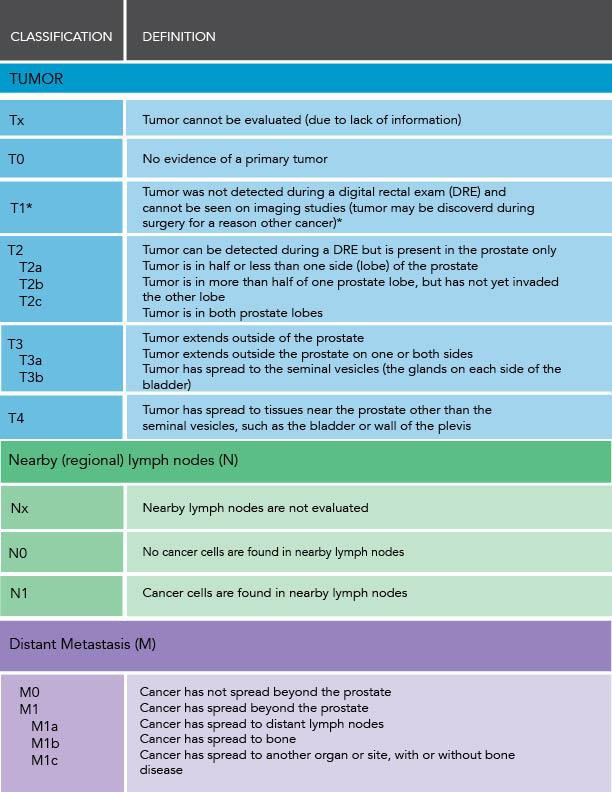
Treatment depends on the staging and grade of the disease as well as overall life expectancy and the personal decision of the patient. Options include:
- Watchful waiting: for elderly patients, those with short life expectancy, and those with low grade, low score cancers. They have regular PSAs and will only receive treatment if progression is suspected.
- Endocrine treatment: for progressing disease, locally advanced disease, and metastatic disease.
- Antiandrogens e.g., Bicalutamide
- LHRH agonists treatment e.g., Zoladex
- Bilateral orchidectomy
- Diethylstilbestrol
- Radiotherapy: for localized disease in patients with a life expectancy of over 10 years. Also used to manage pain in palliative therapy.
- Transurethral resection of the prostate (TURP): for low-grade, low-score cancers with significant bladder outflow obstruction.
- Radical prostatectomy: for localized disease in patients with a life expectancy of over 10 years. A pelvic lymph node biopsy is initially done to exclude metastasis.
- Chemotherapy: e.g., taxane, 5FU, for hormone-resistant cancers.
- Palliative care: terminal care for those with hormone-resistant cancer.
Treatment combination depends on the stage or advancement of the disease.
- Retention of urine
- Infection
- Stone formation
- Hydroureter, hydronephrosis, renal failure
- Uremia
- Complications of surgery: erectile dysfunction, incontinence of urine, urethral stricture, bleeding, etc.
- Screening strategies: DRE, PSA
- Avoidance of known risk factors
- Chemoprevention: finasteride
- Prognosis depends largely on the stage at presentation. Those with localized tumors at presentation can be treated radically and have a normal life expectancy.
- Those with advanced or metastatic disease at presentation have a median 3-year survival.
- However, some with noncurable hormone-resistant cancers can live many years, and a large number die from causes other than prostate cancer. Only a few over 20% die from the cancer.
The future prospect of prostate cancer includes early diagnosis, better staging, and chemoprevention. Public awareness amongst the masses as well as detection of people at risk with institution of chemoprevention will relieve or address some of the disease burden.

Practice Questions
Check how well you grasp the concepts by answering the following questions...
- This content is not available yet.
Send your comments, corrections, explanations/clarifications and requests/suggestions